


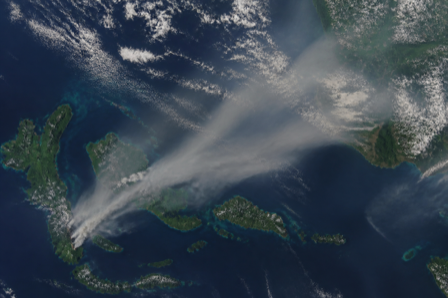
Smoke does not carry a passport. When Indonesian fires burn during the dry season, the haze they produce drifts across seas and borders, which is why a fire in one country becomes a public-health emergency in three or four others. Clearing it is a regional problem, not a national one.
The recurring Southeast Asian haze is, at its core, a geography problem. Fires burn in Indonesia, winds carry the smoke, and neighboring countries breathe the result. That is why the response cannot stop at any one nation’s edge, and why the region built a framework to coordinate. Here is how the smoke actually travels and what ASEAN does when it does.
In Brief
Fires in Indonesia’s Sumatra and Kalimantan regions produce huge volumes of smoke, especially from peatlands, and seasonal winds carry it across borders into Malaysia, Singapore, Brunei, the Philippines, and at times as far as southern Vietnam. Because the haze is transboundary, countries coordinate through ASEAN, including a regional haze agreement and a coordinating center that raises alert levels and shares monitoring. This year, an already dry season made the episode more severe. No single measure clears the haze; it eases mainly when the rains and winds change.
How the Smoke Crosses Borders
The mechanism is straightforward meteorology. Fires in southern Sumatra and parts of Kalimantan release smoke that prevailing seasonal winds push northward and eastward. From there it settles over Malaysia and Singapore, reaches Brunei and the Philippines, and in a strong episode drifts to the edges of the mainland. Regional monitoring centers track the plumes with satellite imagery, mapping hotspots and smoke trajectories day by day, work coordinated in part through the ASEAN Specialised Meteorological Centre.
Why Peatland Fires Are So Hard to Stop
The reason these fires produce so much haze comes down to what is burning. Much of the affected land is peat, partially decayed organic matter that holds carbon and, when dry, smolders rather than burns cleanly. Peat fires can creep underground, resist rain, and release dense smoke for weeks. A dry season makes all of this worse by drying the peat out, and 2026 was flagged in advance as a high-risk year for exactly that reason, as the Singapore Institute of International Affairs noted in its annual haze outlook.
The Regional Framework: ASEAN’s Haze Agreement
Because no country can fix another’s fires from the outside, Southeast Asian nations addressed the haze collectively through the ASEAN Agreement on Transboundary Haze Pollution. It commits members to cooperate on monitoring, prevention, and response, and it created coordinating machinery that can raise regional alert levels as conditions worsen. When an episode escalates, that shared alert system is how the region signals that this is no longer a local event.
| Area | Role in this episode |
|---|---|
| Sumatra and Kalimantan (Indonesia) | Fire sources; heaviest local smoke |
| Malaysia | Heavy haze, with school closures in Sarawak |
| Singapore | Unhealthy air readings and advisories |
| Brunei and the Philippines | Smoke reached, with local alerts |
| Southern Vietnam | Smoke reported as the episode peaked |
What Countries Are Doing Together
Coordination during an active episode is practical. Indonesia files situation reports and shares smoke-trajectory maps; the regional coordinating center raises its alert level as hotspots multiply; and affected countries deploy their own measures, from Malaysia’s cloud-seeding flights meant to encourage rain to shared health advisories. None of it is a switch that turns the haze off, but it lets governments prepare, warn residents, and direct resources where the smoke is heading next rather than only where it already is.
Why It Keeps Coming Back
The uncomfortable truth is that the haze is a structural, recurring problem, not a one-off accident. It returns whenever a dry enough season meets fire-prone peatland, and climate patterns like El Niño load the dice toward worse years. Long-term solutions involve land management, fire prevention, and peatland restoration, which are slow and complex. In the near term, the region’s tools are mostly about coping well: monitor early, coordinate across borders, and protect people while waiting for the weather to turn. For a household protection guide, see our haze safety explainer, and for the country advisories, our advisory roundup.
This article is general information, not medical or policy advice. Air quality changes hour to hour, so follow official local advisories from your national environment or health agency for real-time guidance.
Frequently Asked Questions
Why does Indonesian haze affect other countries?
Because smoke travels on the wind. Fires in Sumatra and Kalimantan release large amounts of smoke that seasonal winds carry across borders into Malaysia, Singapore, Brunei, the Philippines, and sometimes southern Vietnam, making a local fire a regional air-quality problem.
What is the ASEAN haze agreement?
It is the ASEAN Agreement on Transboundary Haze Pollution, a regional pact committing member countries to cooperate on monitoring, preventing, and responding to cross-border haze. It supports shared alert levels and coordination during severe episodes.
Why are peatland fires so smoky?
Peat is dense organic material that smolders rather than burning cleanly, especially when dry. Peat fires can spread underground, resist rain, and produce thick smoke for weeks, which is why they generate so much haze compared with ordinary vegetation fires.
Can cloud-seeding stop the haze?
It can help locally by encouraging rain that dampens fires and clears some smoke, and Malaysia has used it during this episode. But it depends on suitable clouds and is a coping tool, not a cure. The haze mainly eases when seasonal rains and wind shifts arrive.
Why does the haze keep returning every year?
It is a structural problem: dry seasons combined with fire-prone peatland reliably produce smoke, and climate patterns like El Niño make some years worse. Lasting solutions require slow work on land management and peatland restoration.
What To Know
The haze is a reminder that some problems are shaped like a map rather than a border. A fire in one country becomes everyone’s air, which is why the response has to be shared: common monitoring, common alerts, and common patience while the weather does the heavy lifting. Until the structural drivers are addressed, the realistic goal each dry season is to see it coming and cope well, together.