


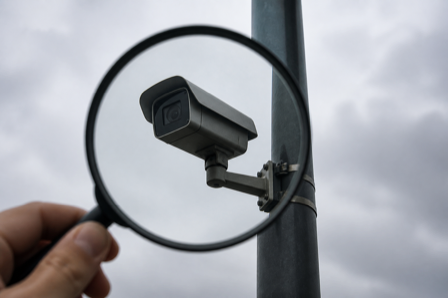
When Grass Valley’s canceled cameras reappeared, the easy story was a vendor glitch. The harder, more useful story is that nobody’s specific job was to confirm the cameras stayed gone. That is an oversight gap, and it is not unique to one town.
A California city voted to end its contract with a surveillance-camera company, removed the hardware, and considered the matter closed. Then some cameras were reinstalled, and the city had to intervene again. Whatever the cause, the episode exposes a question most communities never think to ask until it is too late: after you fire a surveillance vendor, who actually verifies it is gone?
Bottom Line First
Canceling a surveillance contract is a decision, but making it real is a process with several steps: removing hardware, cutting the vendor’s system access, stopping automated maintenance, confirming data is deleted, and verifying none of it quietly restarts. The Grass Valley case showed that a gap anywhere in that chain can undo the decision. Stronger oversight, meaning explicit termination-verification, audit rights, and someone accountable for confirming the vendor stood down, is what turns a cancellation vote into an actual off switch. For the full account of what happened, see our report on the Grass Valley cameras.
The Gap the Case Exposed
The reinstalled cameras were attributed to an automated system generating replacement work orders before the cancellation fully processed, carried out by a contractor who had not been told the deal was over, as local reporting detailed. Read that carefully and the oversight problem jumps out. The city made a clear decision, but the decision did not automatically propagate through the vendor’s systems and subcontractors. There was no single checkpoint that said: confirmed, everything is off.
Why “Cancel” Isn’t a Clean Off Switch
Modern surveillance tools are services, not merely hardware, and services have more moving parts than a physical device. Canceling one can leave several things running unless each is explicitly shut down:
- The physical cameras, which someone has to remove and keep removed.
- The vendor’s back-end access to the system and its data.
- Automated maintenance that may treat an offline camera as a fault to fix.
- Data already collected, which sits somewhere until it is confirmed deleted.
- Subcontractors who act on the vendor’s instructions, not the city’s.
A cancellation that addresses only the first item leaves the rest as loose ends, which is roughly what happened here.
What Real Oversight Would Require
The fix is not exotic; it is contractual and procedural. Meaningful oversight of a surveillance vendor would build in explicit steps: a written termination that lists exactly what must stop, a required confirmation from the vendor that access and work orders are canceled, verification that stored data is deleted, and a named official or body responsible for signing off that all of it happened. Audit rights, the ability to independently check the vendor’s compliance, turn “they told us it’s off” into “we confirmed it’s off.”


The Accountability Problem
Underneath this is an asymmetry. The vendor understands its own systems far better than the city does, so the city is often trusting the vendor to confirm the vendor complied. That works until it does not. Surveillance contracts concentrate a lot of capability, physical cameras, data pipelines, and the kind of cross-agency data access that privacy groups track, in the hands of a private company, and the public body on the other side may not have the technical staff to verify the shutdown independently. Closing that gap is less about any single company’s conduct and more about how cities structure these deals in the first place.
What Cities and Residents Can Push For
Communities that want real control can ask for it before signing, or at renewal: termination clauses that specify a verification process, mandatory data-deletion confirmation, independent audit rights, and public reporting when a contract ends. Residents can press councils to treat cancellation as a project with a sign-off, not a one-time vote. For more on local government and technology, browse Visboo’s News section.
Frequently Asked Questions
Why did canceling the contract not stop the cameras?
Because a cancellation is a decision, not an automatic technical shutdown. In Grass Valley, hardware removal happened, but a vendor’s automated system and a subcontractor continued acting until the termination fully processed, showing that each part of the shutdown needs to be explicitly confirmed.
Who is responsible for confirming a surveillance vendor left?
Often no one clearly is, which is the oversight gap. Strong contracts assign a named official or body to verify that hardware, system access, automated maintenance, and stored data are all shut down and deleted, rather than assuming the vote alone accomplishes it.
What are audit rights in this context?
Audit rights let a city independently verify a vendor’s compliance rather than relying on the vendor’s word. For surveillance contracts, that can mean confirming access is revoked, work orders are canceled, and collected data is actually deleted after termination.
Is this a problem with one company or the whole model?
It is more about how the deals are structured. Any surveillance service concentrates capability with a private vendor while the public body may lack the technical means to verify a shutdown. The lesson applies across vendors, not to a single one.
What can residents do?
Push local officials to include termination-verification and data-deletion requirements and audit rights in surveillance contracts, and to treat a cancellation as a process with a formal sign-off. Public reporting when contracts end also helps keep the shutdown accountable.
What This Means
The most quotable detail from Grass Valley is that the cameras came back, but the durable lesson is quieter. A cancellation is only as strong as the process that enforces it, and surveillance contracts rarely spell that process out. The communities that avoid a repeat will be the ones that decide, in advance, exactly who confirms the off switch actually worked.