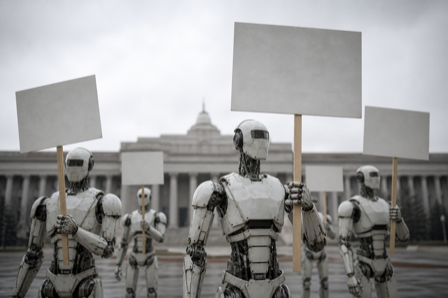
A line of robots waving flags and holding placards outside a government ministry is the kind of image that stops a scroll. It was designed to. The Warsaw demonstration was pure theater, but the anxiety it staged, about what automation does to human work, is anything but a joke.
In September 2026, roughly thirty robots “protested” outside Poland’s Ministry of Digital Affairs, calling for tighter rules on artificial intelligence and automation. Organized by a civic group, the stunt was a piece of political performance art, and an effective one. Behind the spectacle sits a genuine debate about jobs, regulation, and worker protections that governments everywhere are grappling with. Here is what happened and why the message landed.
The Short Version
About thirty humanoid and four-legged robots staged a mock protest outside Poland’s Ministry of Digital Affairs in Warsaw in September 2026, organized by a civic initiative to demand stronger AI and automation regulation and job protections. The robots waved Polish flags and carried slogans urging lawmakers to act. It was a symbolic demonstration, not a literal machine uprising, meant to dramatize concerns about automation’s effect on the labor market. The stunt drew wide attention precisely because the underlying worry, that AI could displace human jobs faster than policy can respond, is a serious and unresolved issue.
What Actually Happened
Around thirty robots, both humanoid and quadrupedal, gathered outside the Ministry of Digital Affairs in Warsaw, performing coordinated movements, waving Polish flags, and displaying messages calling for AI regulation and job protection, as Notes From Poland reported. The demonstration was organized by a civic initiative aiming to spark public debate about how AI is reshaping society and work. Video of the scene spread quickly, as CNN’s coverage showed.
The Point of the Stunt
Making robots the protesters was the whole idea. By having machines “demand” rules that protect human workers, the organizers created a deliberately uncanny image of the future people might face as automation advances. It is protest as metaphor: the robots stand in for the very technology that could displace workers, turning an abstract policy debate into something visual and shareable. Whether or not you find the format gimmicky, it accomplished its goal of getting the conversation noticed.
The Real Debate Underneath
Strip away the costumes and the substance is serious. Governments and workers worldwide are wrestling with how quickly AI and automation might reshape employment, and whether policy can keep pace. The demonstration channeled a set of real questions:
| The stunt’s “demand” | The real policy question |
|---|---|
| “We want regulations” | How should AI and automation be governed? |
| “Protect jobs” | What safety nets fit an automating economy? |
| Machines as protesters | How fast will automation displace roles? |
| Public attention | Can policy move at the speed of the technology? |
Why Symbolic Protests Work
Dry policy debates struggle for attention; a crowd of flag-waving robots does not. The stunt worked because it compressed a complex issue into a single arresting image that travels well online and in news clips. That is a legitimate tactic for civic groups trying to force a slow-moving topic onto the public agenda, and it mirrors how climate and other movements have used striking visuals to cut through. The risk is that the spectacle overshadows the substance, which is why the follow-up conversation matters more than the clip.
What Worker Protections Are Actually on the Table
The proposals in this space are familiar even if the messenger was novel: clearer rules on how AI is deployed in workplaces, investment in retraining and reskilling for displaced workers, transparency about automation decisions, and social safety nets designed for a labor market in flux. None of these are simple, and reasonable people disagree on the right mix, but they are the concrete debates the robots were gesturing toward. The demonstration did not resolve them; it pointed at them.
What It Means
The Warsaw robots will be remembered as a clever image, but the value is in what comes after the laughter and the shares. Automation’s effect on work is one of the defining policy questions of the decade, and stunts like this succeed only if they push real debate forward. For more on technology and society, browse Visboo’s News section and our Technology coverage.
Frequently Asked Questions
Did robots really protest in Poland?
Yes, in a staged sense. About thirty robots were arranged to “protest” outside Poland’s Ministry of Digital Affairs in Warsaw in September 2026, organized by a civic group to demand AI regulation and job protection. It was a symbolic demonstration, not an autonomous machine action.
Who organized it and why?
A civic initiative organized it to spark public debate about how AI and automation are reshaping society and the labor market. Using robots as the protesters was a deliberate way to dramatize concerns about technology displacing human jobs.
Was it a real protest or performance art?
It was performance art with a political message. The robots did not act on their own; they were staged to make an abstract policy debate vivid and shareable, which is why the imagery spread so widely.
What are people actually worried about?
That AI and automation could displace jobs faster than policy, retraining, and safety nets can adapt. The demonstration channeled calls for regulation, worker protections, and transparency about how automation is deployed.
What protections are being discussed?
Common proposals include workplace AI rules, investment in reskilling for displaced workers, transparency requirements, and updated social safety nets. There is no consensus on the right approach, which is part of why the debate continues.
What To Watch
The clever part of the Warsaw stunt was letting machines carry a message about people. The lasting question is whether the attention converts into policy, or fades with the next viral clip. Automation is not waiting for governments to catch up, and that mismatch, not the robots themselves, is the real story worth following.