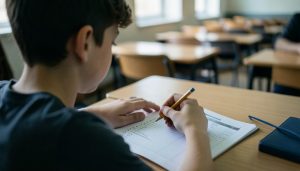
The scores fell again, and the more interesting question is not by how much. It is why, and the answer the data keeps pointing at is sitting in almost every teenager’s pocket.
When the OECD released the PISA 2025 results this month, the headline was the decline: reading and math at their lowest recorded levels across wealthy countries. The follow-up question everyone actually wants answered is what is causing it. The test itself gathered a lot of clues, and most of them circle back to attention, screens, and how kids study now.
The Short Version
PISA 2025 scores are falling because of a cluster of pressures rather than one cause, but attention is the thread running through most of them. The OECD found phones distracting students in class, screen time crowding out reading for pleasure, and a notable detail: students who leaned on AI chatbots for schoolwork tended to score lower than those who did not. None of these is a lone smoking gun, and the countries that held steady tended to be the ones that protected focus most aggressively. For the full picture of the decline itself, see our overview of the PISA 2025 results.
The Phone in the Classroom
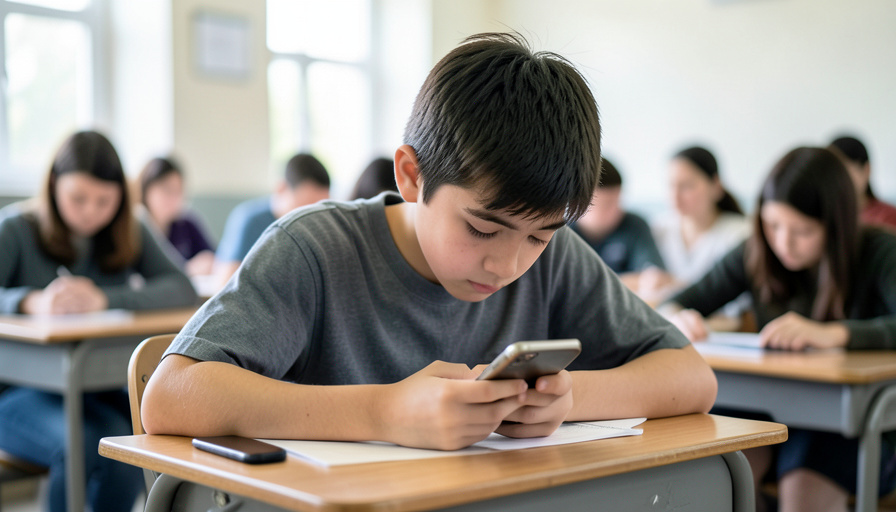
Start with the most concrete finding, because it is hard to argue with. Roughly one in four students told PISA that classmates are distracted by devices in most or every science lesson. That is not screen time at home. That is attention leaking out of the room during instruction, in real time, at scale.
It helps explain a pattern that had puzzled some researchers. Reading suffered the steepest drop of any subject, and reading is the skill most punished by fractured attention. You cannot skim your way through a dense passage the way you skim a feed. The OECD’s PISA 2025 report lays out the device-distraction data alongside the score declines.
Shrinking Attention and Vanishing Reading
Behind the in-class distraction sits a slower change. Reading for pleasure keeps declining, year over year, across most participating countries. When teenagers read less for fun, they get less of the daily, low-stakes practice that builds the stamina a test like PISA rewards.
Attention spans come up repeatedly in the OECD’s analysis, and the mechanism is not mysterious. A brain trained on short, fast, endlessly refreshing content finds a long static passage genuinely harder work. That is a habit, not a verdict, which matters because habits can be changed.

The AI Wrinkle Worth Watching
Here is the finding that will get argued about for years. Students who reported using AI chatbots for their schoolwork tended to score lower than students who did not, a pattern noted in European coverage of the results.
Worth being careful here. Correlation is not cause. It could be that struggling students reach for chatbots more, rather than chatbots making students struggle. But there is a plausible mechanism too: if an AI does the thinking, the student skips the productive difficulty that actually builds skill. Either way, it is a signal schools cannot ignore while they scramble to write AI policies.
It Is Not Only the Kids
One caveat worth flagging before this turns into a lecture about teenagers. The OECD also points to declining parental engagement and, less comfortably, adults’ own screen habits. Something as small as regularly talking with a child about their school day correlates with better outcomes, and fewer families are doing it. Add rising absenteeism and teacher shortages, and the score drop starts to look like the sum of a lot of small withdrawals of attention, by everyone.
What the Countries That Held Steady Did
The most useful evidence comes from the systems that did not slide. Several of them leaned back toward explicit, direct instruction and the science of how learning works, and a number moved to restrict phones during the school day. That is not proof that phone bans alone rescue scores, but the correlation is pointed enough that education ministers across Europe are treating it as a lever. For more education coverage, browse Visboo’s Education section.
What Parents and Schools Can Actually Do
The interventions that show up alongside better outcomes are unglamorous and cheap:
- Protect focused time. Phone-free stretches at school and at home give attention a chance to rebuild.
- Bring back reading for pleasure, even ten minutes a day, on paper when possible.
- Use AI as a tutor that asks questions, not an oracle that hands over answers.
- Talk with kids about their day. It is the lowest-effort, best-evidenced habit on this list.
None of it is dramatic. That is rather the point. The declines came from a thousand small distractions, so the recovery probably comes from a thousand small corrections.
Frequently Asked Questions
What is the main reason PISA scores are falling?
There is no single reason. The OECD points to a cluster of factors, with attention as the common thread: phones distracting students in class, declining reading for pleasure, shrinking attention spans, and lower parental engagement. Reading, the skill most hurt by fractured attention, fell the most.
Do phones in the classroom really lower test scores?
The data shows a strong association. About one in four students reported classmates being distracted by devices in most or every lesson, and several countries that restricted school phones held their scores steadier. It is correlation rather than proof, but it is consistent enough that many systems are acting on it.
Did using AI chatbots hurt students’ scores?
PISA found that students who used AI chatbots for schoolwork tended to score lower, but this is a correlation. It may be that weaker students use them more, or that offloading the thinking skips the effort that builds skill. It is a signal to watch, not a settled cause.
Is this just a pandemic effect?
No. Scores were already declining before 2020 and kept falling after schools reopened, so researchers describe a longer trend. The attention and screen-time pressures predate and outlast the pandemic disruption.
What can parents do at home?
Protect phone-free focus time, encourage daily reading for pleasure, treat AI as a tutor that prompts thinking rather than a shortcut, and simply talk with your child about school. These low-cost habits line up with better outcomes in the data.
What This Means
The PISA 2025 decline reads less like a mystery and more like a bill coming due for a decade of divided attention. The encouraging flip side is that attention is trainable and the countries protecting it are already seeing steadier results. If schools and families treat focus as something to defend rather than assume, the next cycle does not have to keep sliding. The tools that fractured attention are not going away, so the habits around them are where the fight actually is.