The scores hit the lowest levels the world’s biggest school test has ever recorded, and the slide started years before anyone had heard of COVID.
On September 8, 2026, the OECD released the results of PISA 2025, the international test that measures how well 15-year-olds read, do math, and understand science. The headline is blunt. Across wealthy countries, reading scores have fallen 28 points and math 22 points since 2015, the steepest declines the program has ever measured. In plain terms, the reading drop works out to roughly a year and a half of lost learning.
Short Answer
PISA 2025, released in September 2026, shows the worst reading and math results the OECD has recorded since the test began. About one in five 15-year-olds now struggles with the basics in all three subjects. The important part is that this is not a pandemic dip that will bounce back. Scores were already falling before 2020 and kept falling after schools reopened, which points to something slower and more structural. (The test runs on a three-year cycle, so the 2025 round is the one that landed in 2026.)
What PISA Actually Measures
PISA stands for the Programme for International Student Assessment, run by the OECD every three years since 2000. It tests a sample of 15-year-olds across dozens of countries and partner economies on reading, math, and science, and each cycle spotlights one subject in depth. This round, the focus was science, and the test added a new module on computational problem-solving.
What makes PISA matter more than a national exam is the comparison. It is the closest thing the world has to a common yardstick for whether teenagers can apply what they learned rather than only recall it. When that yardstick moves, education ministers pay attention, which is exactly what happened this month. The full findings sit in the OECD’s PISA 2025 report.
How Steep Is the Drop?
Steep enough that the OECD used the word “worst” about its own record. Reading fell 28 points across the average OECD country over the past decade, math 22 points. A rough rule of thumb treats about 20 points as a year of schooling, so the reading decline alone is close to a year and a half of learning that is simply not there.
The share of struggling students tells the same story from another direction. Around 20 percent of 15-year-olds now count as low performers in reading, math, and science together, meaning they cannot reliably handle basic tasks in any of the three. That is a lot of teenagers heading toward adulthood without the floor of skills most jobs assume.
This Is Not a Pandemic Blip
Here is the finding that should reframe the whole conversation. It is tempting to blame lockdowns and move on, but the data does not cooperate. Scores had already turned down between 2018 and 2022, and instead of recovering once classrooms reopened, they stagnated or kept dropping into 2025.
Samuel Greiff, a researcher who worked on the assessment, put it plainly in coverage of the German results: this is “not a short-term phenomenon” but “a clear downward trend” visible across roughly a decade. His line about the pandemic having “a long, long tail” captures the mood. Whatever is dragging scores down was in motion before 2020 and is still in motion now.
Which Countries Held Up, and Which Didn’t
Before the rankings, one caveat worth flagging: a few countries, including the United States, carry a data asterisk for incomplete school participation, so treat their specific numbers with some caution. With that said, the pattern across systems is clear.
| Country or group | PISA 2025 signal |
|---|---|
| Singapore, Japan, and East Asian systems | Still the top performers |
| Estonia, Finland, Ireland, Poland | Above the OECD average |
| Germany | Lowest since testing began 25 years ago |
| Spain, Denmark | Worst national results on record |
| Türkiye | A positive outlier with the largest OECD gain |
| United States | Rank rose as others fell faster, but absolute scores sit near historic lows (data asterisk) |
The uncomfortable subplot for the United States is that “climbing the rankings” happened mostly because peers fell harder, not because American teens improved. Chalkbeat’s breakdown makes that distinction well.
What’s Driving It
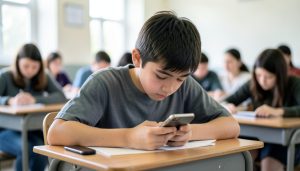
The OECD points to a cluster of pressures rather than one villain, and most of them will sound familiar to any parent or teacher. Shrinking attention spans and heavy screen time come up repeatedly, along with phones in the classroom: roughly one in four students said classmates are distracted by devices in most or every science lesson. Reading for pleasure keeps declining. So does parental engagement. Add rising absenteeism, classroom disruption, and teacher shortages, and you have a lot of small leaks in the same boat.
One newer wrinkle stood out. Students who reported using AI chatbots for schoolwork tended to score lower than those who did not. That does not prove the chatbots caused it, but it is the kind of correlation the next few years of research will chew on. Related reading on how screens reshape daily habits sits in Visboo’s Technology section.
What It Means for Schools and Parents
The countries that held steady offer the most useful clue. Several of them leaned back into explicit, direct instruction and the basics of how learning actually works, rather than chasing the newest classroom trend. That is not a magic fix, but it is a direction.
For parents, the least glamorous finding may be the most actionable: simply talking with your kid about their school day, and modeling reading and focus rather than scrolling, correlates with better outcomes. For a broader look at family routines and screen habits, see Visboo’s Family & Personal section.
Frequently Asked Questions
Why are they called “PISA 2025 results” if they came out in 2026?
Because the test was administered in 2025 and the OECD publishes the full analysis roughly a year later. The first volume of PISA 2025 was released on September 8, 2026, with two more volumes expected in 2027. There is no separate “PISA 2026” cycle; the program runs every three years.
How big is the score decline, really?
Across OECD countries, reading fell 28 points and math fell 22 points over the decade to 2025. Using the common rule that about 20 points equals a school year, the reading drop is roughly a year and a half of learning, and the OECD calls it the worst on its record.
Is the pandemic to blame?
Only partly. Scores were already falling before 2020 and kept sliding after schools reopened, which is why researchers describe a longer downward trend rather than a one-time COVID shock.
Which countries did best?
Singapore, Japan, and other East Asian systems remained the top performers. Within the OECD, Estonia, Finland, Ireland, and Poland stayed above average, and Türkiye stood out for gaining ground while most countries lost it.
What can parents actually do about it?
The research points to simple, consistent habits: talk with your child about school, protect time for reading, and limit classroom-style distractions like constant phone use at home. None of it is dramatic, but the patterns show it adds up.
Practical Takeaway
PISA 2025 is less a single bad headline than a confirmation that a decade-long slide is real and did not stop when classrooms reopened. The scores that matter are not the rankings, which shuffle as countries rise and fall against each other, but the absolute floor of skills teenagers walk away with. Watch the two follow-up volumes in 2027 for the deeper story on equity and technology, and in the meantime, the boring fundamentals, attention, reading, and steady instruction, are where the countries that held on put their effort.