Your monitor flashes 150-something and your stomach drops. Before you panic or spiral into salt guilt, know this: a startling home reading is often the cuff or your posture talking, not your arteries. Small setup errors can each pad your number by 5, 10, even 20 points, and they stack on top of each other. Here are 11 common measurement mistakes that push a home blood pressure reading higher than it should be, plus the quick fix for every one.
None of this means you should ignore a genuinely high number. It means you should get an honest one first. Fix the setup, take the reading again, and you will know whether you are looking at a real trend or a technique problem you can solve in about five minutes.
The Short Version
Most home blood pressure readings that look too high come from how the reading was taken, not from a sudden change in your health. The biggest offenders are a cuff that does not fit, a cuff placed over clothing, an unsupported arm or back, a full bladder, talking during the measurement, and skipping the rest period. Correct those, average two readings a minute apart, and compare the honest number to your target.
The 11 mistakes at a glance
- Cuff too small for your arm: can add up to 20 mmHg
- Cuff wrapped over a sleeve: up to 50 mmHg on a thick sleeve
- Cuff loose or placed in the wrong spot
- Back and feet unsupported: up to about 10 mmHg
- Legs crossed at the knee: 2 to 8 mmHg
- Arm hanging or below heart level: up to about 10 mmHg
- Full bladder: 10 to 15 mmHg
- Talking or scrolling mid-reading: up to about 10 mmHg
- Coffee, nicotine, or a workout in the last 30 minutes
- No five-minute quiet rest first
- Trusting a single reading instead of an average
1. Your cuff is too small for your arm

This is the single most overlooked error, and it only pushes in one direction: up. A cuff that is too narrow for your arm cannot squeeze evenly, so the machine works harder and reports a higher pressure than you have. The American Heart Association puts the typical effect at roughly 2 to 10 mmHg, and a serious mismatch, such as a regular cuff on an arm that needs a large, can inflate a reading by close to 20 mmHg. A cuff that is too big does the opposite and reads a few points low. Measure the circumference of your upper arm at the midpoint, then check the range printed on the cuff or in the manual. If you are near the top of a size, buy the next one up.
2. You wrapped the cuff over a sleeve

Slapping the cuff over a shirt or sweater feels harmless, but the fabric changes how pressure transfers to your artery. Depending on how thick the sleeve is, clothing can add a surprising amount to the reading, in some cases up to 50 mmHg with a bulky sleeve. Rolling a tight sleeve up to bunch above the cuff is almost as bad, because the wad of fabric acts like a tourniquet. The fix is simple: bare your upper arm entirely, or slip the offending arm out of the sleeve before you start. If a sleeve will not push up without squeezing, take the whole arm out of it.
3. The cuff sits loose or in the wrong spot
Even the right cuff on bare skin will lie to you if it is placed carelessly. A cuff that is too loose has to over-inflate to find your pulse, nudging the number higher, while one that is crooked or too low on the arm reads unpredictably. The bottom edge should sit about an inch above the crease of your elbow, and the tubing should line up over the inside of your arm where the artery runs. Snug is the goal: you want to slide two fingertips under the top edge and no more. Tighten a loose cuff, straighten a crooked one, and make sure it is not riding down toward your elbow.
4. Your back and feet have nothing to lean on
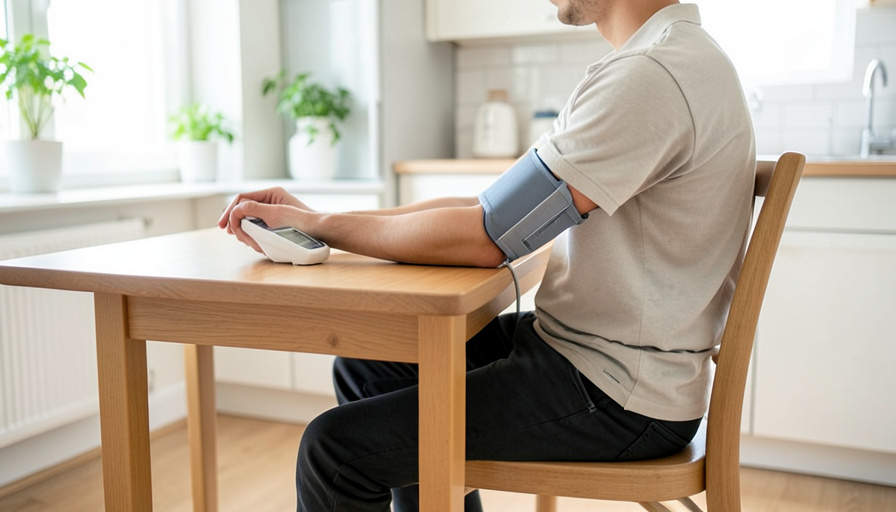
Perching on a stool, a bed edge, or an armless bench quietly raises your reading. When your back is not supported, your body does small isometric work to hold you upright, and that effort can lift systolic pressure by up to about 10 mmHg. Dangling feet do the same thing on a smaller scale. Sit in a chair with a real back, plant both feet flat on the floor, and let the chair hold you. If your feet do not reach, use a footrest or a stack of books. It feels fussy, but posture is one of the cheapest points you will ever save.
5. You crossed your legs
Crossing your legs at the knee is a reflex, and it reliably bumps systolic pressure by 2 to 8 mmHg while the cuff inflates. The crossed position raises resistance in your circulation for as long as you hold it. Crossing at the ankles has a much smaller effect, but the cleanest habit is to keep both feet flat and uncrossed for the whole reading. Uncross before you press start, not after the cuff is already squeezing.
6. Your arm is below heart level

Where your arm sits matters as much as where you sit. If the cuff is below the level of your heart, gravity adds pressure and your reading climbs, by up to roughly 10 mmHg if the arm is hanging at your side. Hold the arm too high and it reads low. The target is to have the cuff at about mid-chest height, which happens naturally when you rest your forearm on a table with the palm up. The MedlinePlus medical encyclopedia spells out the same rule: your arm should be supported so the upper arm is at heart level, not held up in the air by your own muscles. Support the arm, do not flex it.
7. Your bladder is full
A full bladder is an easy one to forget and it is not small: it can raise systolic pressure by 10 to 15 mmHg. The discomfort triggers a mild stress response that your monitor reads as blood pressure. If you measure first thing in the morning, that is often exactly when your bladder is fullest. Use the bathroom before you sit down to measure, then take your rest period. This single habit removes a chunk of morning readings that scare people for no reason.
8. You were talking or scrolling mid-reading
Talking during a measurement, even answering a quick question, can push the number up by around 10 mmHg. Listening and responding, mentally composing a reply, or thumbing through your phone all keep your nervous system busy while the cuff is trying to catch a resting value. Set the phone down, stop the conversation, and let the machine work in silence. If someone asks you something while the cuff is inflating, wait until it finishes to answer. Quiet is part of the technique, not a bonus.
9. Coffee, a cigarette, or a workout came first
Caffeine, nicotine, and exercise all raise blood pressure for a while, so a reading taken soon after any of them reflects the stimulant, not your baseline. Guidance is to avoid coffee, smoking, and hard activity for at least 30 minutes before you measure. A brisk walk to the mailbox, a strong espresso, or a cigarette can each keep your number elevated well past when you feel back to normal. If you just did one of these, wait out the half hour before you trust the result. Morning readings are best taken before your first coffee for exactly this reason.
10. You skipped the five-minute sit
Sitting down and immediately measuring almost guarantees a high first number, because your body is still settled from moving around. The standard advice is to rest quietly for at least five minutes before the cuff inflates, and ten minutes is better if you have been rushing. Use the time to sit still, breathe normally, and let your heart rate drift down. Do not use those five minutes to answer email or scroll the news, which defeats the point. Just sit. The reading you get after a real rest is the one worth writing down.
11. You trusted a single reading

Blood pressure moves minute to minute, and the first reading of a session tends to run higher than the ones that follow. Home guidance is to take two or three readings about a minute apart and average them, rather than reacting to whichever number shows up first. If your monitor stores results, log them at the same times each day, morning and evening, for a week before you draw any conclusions. One high number on one morning is a data point, not a diagnosis. A pattern across several days, taken with good technique, is what gives you a real answer.
How We Chose These
We started from the measurement rules that hypertension specialists and the American Heart Association publish for home monitoring, then narrowed the list to the errors that do two things: inflate the reading rather than lower it, and happen often in real kitchens and living rooms, not just clinics. Where a reputable estimate exists for how many points a mistake adds, we included it so you can see which fixes carry the most weight. We leaned toward problems a person can correct alone, with the equipment they already own, in a single sitting. Device-brand quirks, calibration testing, and clinical-only factors were left out to keep the focus on setup you control at home.
This article is general information, not medical advice, and it does not replace guidance from your own clinician. Blood pressure targets and treatment decisions depend on your personal health history. If your readings are consistently high with good technique, if you get a severely high reading with symptoms such as chest pain, trouble breathing, or vision changes, or if you have questions about your monitor or medications, contact a qualified healthcare professional.
Frequently Asked Questions
Can the wrong cuff size change my reading that much?
Yes. A cuff that is too small for your arm is one of the most common reasons a home reading looks high, because it cannot compress evenly. The American Heart Association estimates a typical error of about 2 to 10 mmHg, and a large mismatch can push a reading close to 20 mmHg above your real pressure. Measure the circumference of your upper arm and match it to the range printed on the cuff or listed in the manual, then size up if you fall near the top of a range.
Is it fine to measure over my sleeve if I am in a hurry?
No, the cuff belongs on bare skin. A sleeve changes how pressure reaches your artery and can add a meaningful amount to the number, in some cases up to 50 mmHg with thick fabric. Bunching a tight sleeve above the cuff is nearly as bad, since the roll of cloth squeezes the arm. If you cannot push the sleeve up loosely, take that arm out of the sleeve entirely before you measure.
What arm position gives the most accurate reading?
Rest your forearm on a table or armrest so the cuff sits at about heart level, with your palm up and your arm supported rather than held in the air. An arm hanging below heart level reads high, by up to roughly 10 mmHg, because gravity adds pressure. An arm held too high reads low. Sit with your back supported and both feet flat on the floor at the same time, since posture and arm position work together.
How long should I sit still before I measure?
Rest quietly for at least five minutes before the cuff inflates, and ten if you have been moving around. Use the bathroom first, avoid caffeine, nicotine, and exercise for 30 minutes beforehand, and stay off your phone during the rest. Sitting down and measuring right away is one of the surest ways to get a falsely high first number, because your body has not settled yet.
My first reading is high but the next one is normal. Which do I trust?
Take two or three readings about a minute apart and average them rather than trusting the first one, which is often the highest of the session. Log those averages at consistent times, morning and evening, for several days. A single high reading is a data point, not a verdict. A repeated pattern taken with good technique is what deserves a conversation with your clinician.
The Bottom Line
A home monitor is only as honest as the setup around it. Before you trust an alarming number, run the checklist: right-size cuff on bare skin, back and feet supported, legs uncrossed, arm resting at heart level, empty bladder, no talking, and a real five-minute rest with no coffee or cigarette beforehand. Then take two readings and average them. If the honest number is still high across several days, that is worth acting on, so bring your log to a professional. For more on protecting your heart over the long run, our guide to the potential heart-health benefits of fish oil is a good next read, and the health section has more. You can also see how home devices measure pressure in this overview of blood pressure measurement and the step-by-step technique in the MedlinePlus measurement guide.